
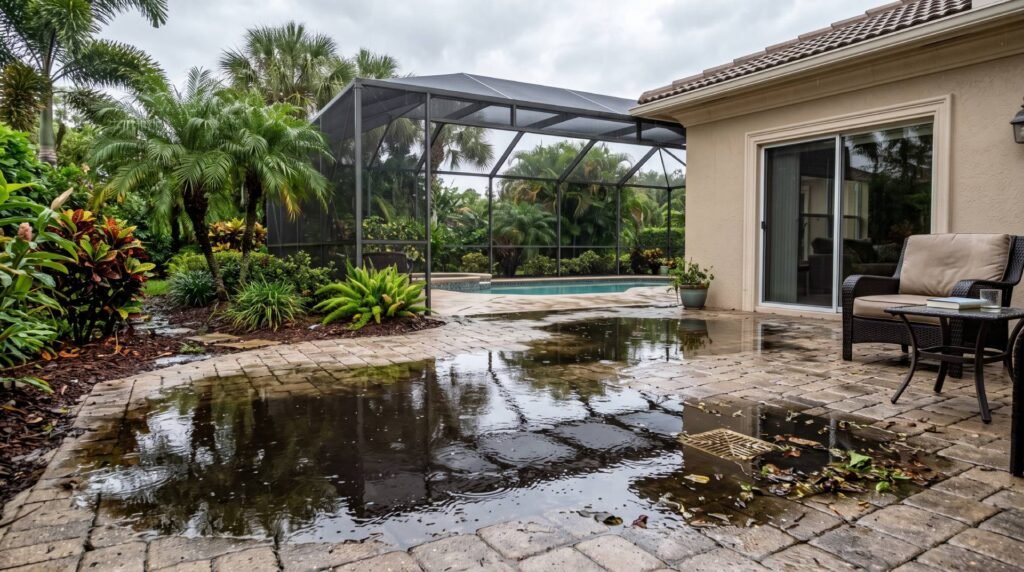
During South Florida’s torrential rainy season, your outdoor space is supposed to serve as a dry, comfortable sanctuary. However, many Miami homeowners face an annoying and potentially hazardous problem: standing water inside the screened patio or overflowing waterfalls spilling over the pool deck.
Water pooling on a patio is rarely just an annoyance—it is an early warning indicator of structural drainage failure. Left unaddressed, trapped rainwater accelerates aluminum corrosion, rots the wooden fascia boards supporting your roofline, attracts mosquitoes, and can even compromise your home’s foundation.
Understanding how screen enclosure drainage works—specifically the critical role of super gutters—is key to keeping your outdoor area dry, protected, and code-compliant.
The Culprit: What Is a “Super Gutter” and Why Is It Failing?
Standard residential gutters are made from thin-gauge vinyl or lightweight aluminum designed solely to catch roof runoff. In contrast, when a pool cage or patio enclosure connects directly to your home’s roofline, standard gutters cannot be used.
Instead, contractors install a super gutter (also known as a structural box gutter).
                [ Home Roof Line ]
                         \
                          \  (Rainwater Runoff)
                           v
   +-------------------------------------------------+
   |                 SUPER GUTTER                    | <--- Heavy-duty extruded aluminum
   +-------------------------------------------------+
       |                                          \
   [ Fascia Board / Wall ]               [ Screen Enclosure Frame ]
A super gutter is a heavy-duty extruded aluminum channel (often 7-inch or 8-inch wide, built from 0.060″ to 0.125″ thick aluminum). It serves a dual mechanical function:
-
Water management: It channels massive volumes of rainwater collected from both the home’s primary roof pitch and the enclosure roof.
-
Structural tie-in: It acts as the load-bearing connection point that anchors the entire screen enclosure frame to your house.
When you notice leaks, overflowing water curtains, or puddles inside the patio, the super gutter or its discharge setup is usually experiencing one of three common issues:
3 Reasons Rainwater Traps Inside Your Screened Patio
1. Inadequate Pitch or Local Low Spots
Gravity dictates drainage. According to the Florida Building Code, roof gutters and downspout systems must maintain adequate fall toward the outlets.
-
In South Florida, gutters typically need an engineered slope (at least 1/16″ to 1/8″ drop per foot of run).
-
When long spans sag or settle over time, a low spot forms. Water stops flowing toward the downspouts, stays trapped in the channel, and cascades backward over the fascia or spills onto your patio deck.
2. Undersized Downspouts and Tropical Deluges
Miami experiences tropical storm microbursts where inches of rain fall in less than an hour. A typical 2×3-inch downspout simply lacks the hydraulic capacity required for a 1,500-square-foot roof feeding into a pool cage.
-
High-capacity super gutter systems require 3×4-inch or 4×5-inch commercial downspouts.
-
If downspouts are undersized or clogged with pine needles, palm fronds, and oak leaves, the gutter backs up within minutes.
3. Compromised Splash Guards and Deteriorated Sealants
Where the super gutter meets your roof shingles or tile drip edge, commercial-grade sealants and aluminum flashing create a watertight barrier. The relentless Miami sun emits heavy UV radiation that degrades polyurethane and silicone sealants within 3 to 5 years. Once the seal fails, water tracks behind the gutter, rotting the fascia wood underneath and dripping down the interior walls of your screen room.
The Hidden Danger: Fascia Rot and Mold Hazards
Allowing rainwater to sit inside your enclosure isn’t just a slip hazard:
-
Hidden Wood Decay: Water backing up into the fascia plate creates moist conditions where wood rot thrives undetected. Because the screen cage hangs from this wood, severe rot can weaken the structure, leaving it susceptible to high winds. To understand the structural demands of South Florida codes, read the Miami-Dade Screen Enclosure Regulations & Wind Load Guide.
-
Pest and Mosquito Harboring: Standing water that persists for more than 48 hours becomes an active breeding pool for pests. The Centers for Disease Control and Prevention (CDC) emphasizes that eliminating standing water around home perimeters is the most effective safeguard against mosquito-borne illnesses like Dengue and West Nile.
Diagnostic Checklist: Inspecting Your Patio Drainage
Before the next storm rolls in, walk your patio perimeter and review this quick checklist:
| Checkpoint | What to Look For | Warning Sign |
| Gutter Seams | Look at joints, end caps, and splices | Water dripping between seams during moderate rain |
| Downspout Discharge | Inspect ground-level drain exits | Water ponding right at the slab base instead of away from the foundation |
| Fascia Board Interface | Check wood underneath the super gutter | Dark soft wood, peeling paint, or musty mildew smell |
| Enclosure Floor Slope | Check the patio deck after rain stops | Water puddling against sliding door tracks or foundation footers |
Professional Drainage Solutions for Miami Homeowners
If water is seeping into your enclosure or overflowing the roofline, simple surface mopping won’t resolve the root issue. Standard solutions include:
-
Re-pitching and Resealing the Super Gutter: Correcting the angle toward the downspouts and replacing deteriorated caulking with marine-grade structural sealant.
-
Upgrading Downspout Capacity: Installing larger commercial-dimension downspouts and leaf-diverters that handle sudden tropical volume.
-
Fascia Repair & Structural Reinforcement: Replacing soft, rotten structural backing with pressure-treated lumber wrapped in custom aluminum capping before securing the enclosure framework.
Protect Your Investment Before the Next Storm
Your outdoor enclosure is designed to protect your pool and enhance your home’s usable living space—not cause drainage headaches. If you notice persistent pooling water, sagging gutter channels, or water tracking down interior patio screens, our team can pinpoint the exact flaw and restore proper drainage flow.
Ready to secure your patio? Schedule a comprehensive assessment with Palacios Screen & Enclosures today:
-
Request a complimentary evaluation: Get a Free Estimate
-
Have questions about your system? Contact Our Experts