
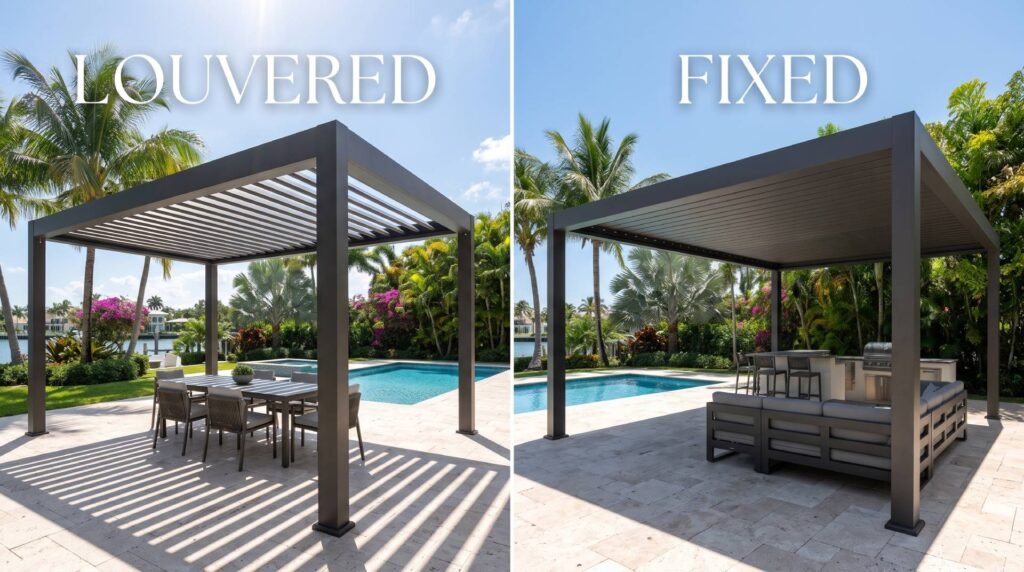
Louvered vs Fixed Aluminum Pergolas: Which Is Right for Your Miami Home?
If you’re planning a pergola in Miami, the first big choice is the roof. A fixed pergola keeps the same slats or panels all year. A louvered pergola has blades you can rotate to let in sun, add shade or close against rain.
Both are made of aluminum, and both can be built for Miami-Dade’s hurricane code. However, they feel very different to live with, and they fit different budgets and backyards. That’s why this guide compares the two side by side so you can pick the one that works for your home.
If you already know you want aluminum, see our main page on aluminum pergolas in Miami. It covers styles, permits and how our installation works.
What Is a Fixed Aluminum Pergola?
A fixed aluminum pergola has a roof that doesn’t move. It comes in two main types:
- Open-slat (trellis) pergolas: spaced rafters and slats that filter the sun and cast a pattern of shade. Rain passes through.
- Solid or insulated roof pergolas: aluminum panels that block sun and rain completely. Insulated panels also keep the space underneath cooler. These are often called aluminum patio roofs.
Fixed pergolas have no moving parts, so there’s very little that can wear out. As a result, they’re the simpler and more budget-friendly option, and they come in many colors, including Alumawood finishes that look like wood.
Best for: homeowners who want dependable shade with almost zero upkeep, or full rain coverage over an outdoor kitchen or dining area.
What Is a Louvered Aluminum Pergola?
A louvered aluminum pergola has a roof made of rotating aluminum blades. You can tilt them open for sun and airflow, angle them for partial shade, or close them flat to block sun and rain. Some people call it a louvered roof pergola or an adjustable pergola.
Most louvered systems include:
- Manual or motorized control: a hand crank, or a motor you run with a remote or a phone app.
- Built-in gutters: water that lands on the closed blades runs into the frame and drains down the posts.
- Options: rain sensors that close the roof automatically, LED lighting, fans and side screens.
On the other hand, the trade-off is cost and complexity. Louvered pergolas have more parts, so they cost more than a fixed pergola of the same size. Motorized systems also need power run to the structure.
Best for: homeowners who want to control the light and use the patio in any weather, from a sunny morning to a summer afternoon storm.
Louvered vs Fixed Pergolas at a Glance
| Feature | Fixed open-slat | Fixed solid roof | Louvered |
|---|---|---|---|
| Shade | Partial, filtered | Full | Adjustable, from open to full |
| Rain protection | None | Full | Full when closed, with built-in gutters |
| Airflow | High | Lower | Adjustable |
| Moving parts | None | None | Blades, plus a motor if motorized |
| Maintenance | Very low | Very low | Low, with occasional cleaning of blades and gutters |
| Relative cost | Lowest | Mid | Highest |
| Power needed | No (unless adding lights or fans) | No (unless adding lights or fans) | Yes, for motorized models |
What Matters Most for a Pergola in Miami
A pergola that works in Ohio won’t always work in South Florida. Before you choose a style, think about these local conditions.
Summer Rain
Miami gets heavy afternoon storms for much of the year. However, an open-slat pergola gives shade but no rain cover. If you want to stay outside during a downpour, you need a solid roof or a louvered roof you can close.
Strong Sun and Heat
The Florida sun is intense, especially over a pool deck. For example, insulated solid roofs keep the area underneath the coolest. Meanwhile, louvered roofs let you angle the blades to block direct sun while hot air escapes between them.
Hurricanes and Miami-Dade Code
Miami-Dade is in Florida’s High-Velocity Hurricane Zone, which has some of the strictest building rules in the country. Because of this, any pergola here, fixed or louvered, should be engineered and anchored for local wind loads. For a louvered system, also ask how the blades should be set before a storm.
Permits and HOAs
In fact, most pergolas in Miami-Dade need a building permit and signed engineering. Many neighborhoods also need HOA approval. For this reason, choose an installer who handles the drawings and permits for you, so the structure passes inspection and doesn’t cause problems when you sell.
Salt Air and Humidity
This is where aluminum beats wood. Unlike wood, it doesn’t rot, rust or attract termites. In addition, a powder-coated finish holds up in coastal air. Moreover, that’s true for both fixed and louvered designs.
Which One Is Right for You?
Choose a fixed open-slat pergola if:
- You want filtered shade over a patio, garden or seating area
- Rain cover isn’t a priority
- Keeping costs low with zero moving parts is the goal
Go with a fixed solid or insulated roof if:
- Full sun and rain protection is a must over your outdoor kitchen or dining table
- You want the coolest possible space underneath
- Letting sunlight through isn’t important to you
A louvered pergola is the better pick if:
- You want sun on cool mornings and shade in the afternoon
- Staying outside during summer storms matters to you
- Extras like motorized control, rain sensors and built-in lighting appeal to you
What Affects the Cost
Every pergola is custom, so the price depends on your project. The main factors are:
- Roof type: open-slat costs least, solid and insulated roofs cost more, and louvered systems cost the most.
- Size: larger footprints need more material, posts and footings.
- Attached or freestanding: freestanding pergolas need extra posts and footings.
- Manual or motorized: motors and electrical work add to a louvered project.
- Engineering and permits: required for most pergolas in Miami-Dade.
- Add-ons: LED lights, fans, privacy panels or screen enclosure walls.
Ultimately, the best way to compare is to get a written quote for both options for your space. Many homeowners are surprised by how the numbers line up once they see them side by side.
Louvered vs Fixed Pergola FAQ
Is a louvered pergola worth it in Miami?
For many homeowners, yes. Miami’s mix of strong sun and sudden rain is exactly what an adjustable roof is built for. Otherwise, if you only need simple shade, a fixed pergola gives great value for less.
Do louvered pergolas leak?
When the blades are closed, a quality louvered roof sheds rain into built-in gutters that drain through the posts. However, very light dripping at the blade edges can happen in heavy storms, depending on the system.
Can a louvered pergola handle a hurricane?
It has to be engineered and installed for Miami-Dade wind loads, the same as a fixed pergola. Also, follow the manufacturer’s guidance on blade position before a storm.
Do I need a permit for a louvered or fixed pergola in Miami-Dade?
In most cases, yes. Both types usually need a permit and signed engineering. For this reason, it helps to hire a local installer who handles it for you.
Can I add screens to a pergola?
Yes. Both fixed and louvered pergolas can be combined with screen walls for shade and bug protection in one structure.
Which needs more maintenance?
Fixed pergolas need almost none beyond an occasional rinse. In contrast, louvered pergolas need the blades and gutters cleaned now and then, and motorized models may need occasional service.
Get Expert Help Choosing Your Pergola
Not sure which style fits your backyard? Palacios Screen & Enclosures has served Miami-Dade for over 19 years. We design, permit and install fixed and louvered aluminum pergolas in Miami, built for Florida weather and Miami-Dade code.
First, we’ll visit your home and measure the space. Then we’ll give you a written quote for the options that make sense, at no cost. Our team speaks English and Spanish.
Get a Free Estimate or call (305) 979-6229. You can also browse our recent projects for ideas.