
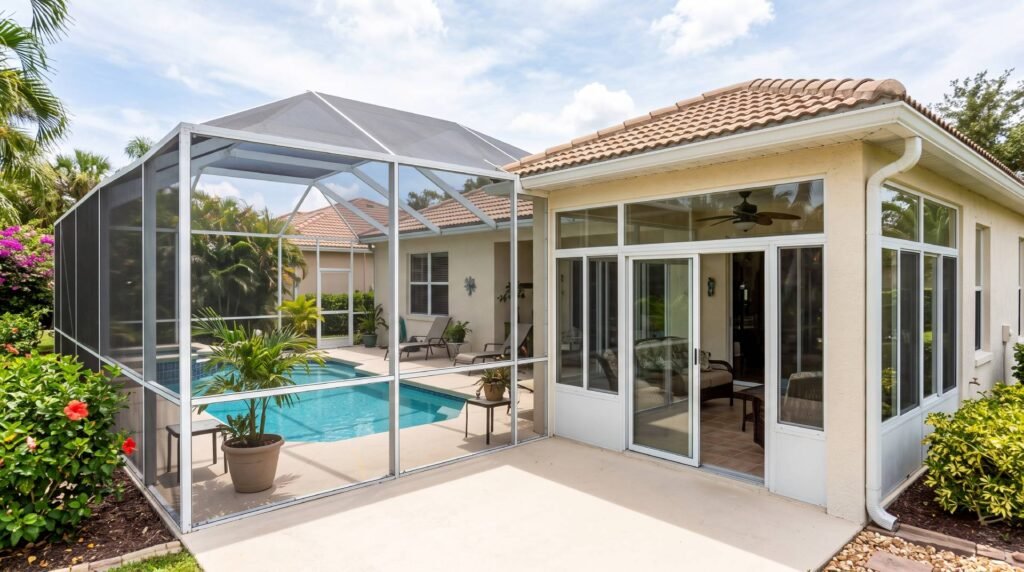
Quick answer: A pool cage is a tall, screened aluminum structure that encloses a swimming pool and deck, so it keeps out insects and debris while it lets in airflow and sunlight. A patio enclosure, on the other hand, is a broader term for a screened or paneled structure that covers a patio, lanai, or living space, whether or not that space includes a pool. In short, a pool cage is a specific type of patio enclosure that follows pool safety codes and uses taller ceiling clearances, while a standard patio enclosure usually focuses on everyday outdoor living.
Because both options look similar from the street, homeowners often ask which one actually fits their property. So, this guide breaks down the differences in structure, cost, purpose, and maintenance, and it helps you decide which option fits your home — or whether you need both.
What Is a Pool Cage?
A pool cage, also called a pool enclosure, uses an aluminum frame and screen panels to cover an in-ground or above-ground pool. Specifically, it does four main jobs:
- It keeps leaves, debris, and insects out of the water
- It reduces pool maintenance and chemical use
- It adds a layer of fall-protection and containment around the pool area
- It cuts down on mosquitos and no-see-ums, so the pool deck stays usable in the evening
Because a pool cage needs to clear diving areas, screen out debris from nearby trees, and meet local wind-load and building codes, contractors typically build it taller than a standard patio enclosure — often 15 to 20+ feet at the roofline.
What Is a Patio Enclosure?
A patio enclosure covers a patio, lanai, or porch that’s attached to the home, and it doesn’t necessarily include a pool. Instead, it supports everyday outdoor living, such as dining, lounging, entertaining, or extending a living room outward. Generally, patio enclosures come in three common styles:
- Screen rooms — all-screen walls and roof, similar in concept to a pool cage but scaled to a patio
- Panel/glass enclosures — vinyl, acrylic, or glass panels that homeowners can open or close depending on the weather
- Solid-roof enclosures (Florida rooms) — insulated or solid roof panels that create a semi-conditioned or fully air-conditioned space
Since pool-specific safety codes don’t govern patio enclosures, they tend to be shorter, more flexible in design, and easier to convert into finished living space.
Pool Cage vs. Patio Enclosure: Side-by-Side Comparison
| Feature | Pool Cage | Patio Enclosure |
|---|---|---|
| Primary purpose | Encloses and protects a pool/deck area | Extends and protects a patio or living space |
| Typical height | 15–20+ ft (clears pool area and diving zones) | 8–12 ft (standard ceiling height) |
| Structure type | All-screen aluminum frame, dome or gable roof | Screen, vinyl panel, acrylic, glass, or solid roof options |
| Code requirements | Must meet local pool-barrier and wind-load codes | Standard patio/porch building codes apply |
| Debris & insect control | Excellent — keeps leaves, bugs, and animals out of the pool | Excellent — keeps insects out of living/dining areas |
| Sun & weather protection | Filters UV and reduces algae growth in the pool | Filters UV and can block rain, depending on panel type |
| Climate control potential | Limited — mainly supports airflow, not conditioning | Homeowners can upgrade it to a conditioned, insulated room |
| Typical cost range | Higher, due to the larger footprint, taller structure, and added engineering | Lower to moderate, thanks to a smaller footprint and simpler engineering |
| Maintenance | Needs regular screen and frame cleaning, plus occasional re-screening | Needs less upkeep for panel/glass systems, though screens need periodic replacement |
| Home value impact | Adds strong value for pool-owning homes | Adds usable living space and curb appeal |
| Best for | Homeowners with an existing or planned pool | Homeowners who want extra outdoor living space, with or without a pool |
Key Differences at a Glance
1. Purpose and design intent A pool cage centers on the pool itself: its footprint, height, and screen panels all work to protect the water and swimming area. A patio enclosure, however, centers on the patio’s footprint and how the homeowner plans to use that space day to day.
2. Height and structure Because it needs to accommodate the open-air feel over a pool and meet local pool-barrier codes, a pool cage stands noticeably taller. A patio enclosure, by contrast, usually matches a standard room height, so it feels more like a natural extension of the home.
3. Material options While a pool cage almost always uses all-screen paneling to maximize airflow and debris filtering, a patio enclosure offers more flexibility — homeowners can choose screen, vinyl, acrylic panels, or glass, depending on whether they want a three-season room or a fully enclosed, conditioned space.
4. Cost Since a pool cage requires a taller structure, a larger screen area, and stricter engineering, it generally costs more than a comparably sized patio enclosure. On the other hand, a patio enclosure can scale up or down more easily to fit different budgets.
5. Regulatory requirements Because a pool cage often intersects with pool safety and barrier codes as well as standard building codes, it can affect design choices like access points and self-closing screen doors. A patio enclosure, meanwhile, only needs to meet standard residential permitting requirements.
Which One Do You Need?
- If you have a pool, or plan to install one: a pool cage is almost always the right call. It protects your investment, cuts down on cleaning and chemical costs, and keeps the swimming area bug-free.
- If you want more usable outdoor living space and don’t have a pool: a patio enclosure gives you a more cost-effective and flexible option.
- If you have both a pool and an adjacent patio or lanai: many homeowners combine both structures into one continuous screened enclosure that covers the whole area.
Either way, a local screen enclosure specialist can assess your lot, pool placement, and local code requirements, and then recommend the right structure and screen type for your property. To get started with no obligation, you can request a free estimate.
Frequently Asked Questions
Is a pool cage the same as a screen enclosure? Yes, in most cases, contractors and homeowners use “pool cage” and “pool screen enclosure” interchangeably. Both terms refer to the same all-screen aluminum structure that covers a pool.
Can a patio enclosure be converted into a pool cage later? Not directly. If you add a pool later, you’ll typically need to modify or replace the existing patio enclosure so it meets the height clearance and code requirements specific to pool enclosures.
Do pool cages increase home value? Yes. In warm, insect-prone climates, buyers generally see a pool cage as a valuable upgrade because it reduces pool maintenance and makes the pool area usable more often.
How long do pool cages and patio enclosures last? With proper care, the aluminum frame typically lasts 20+ years. However, screens usually need replacement every 7–12 years, depending on climate exposure, storm activity, and screen material.
Do I need a permit for a pool cage or patio enclosure? In most jurisdictions, yes. Both structures typically require a building permit and must meet local wind-load requirements, and pool cages must also meet pool-barrier requirements. Fortunately, a licensed contractor handles permitting as part of the project.
Get a Professional Recommendation
Choosing between a pool cage and a patio enclosure ultimately depends on your property, your pool situation, and how you want to use your outdoor space. That’s where the team at Palacios Screens can help: we’ll walk your property, review local code requirements, and recommend the enclosure type, height, and screen material that fits your home and budget.
Ready to move forward? Request a free estimate or contact our team to schedule a consultation.