
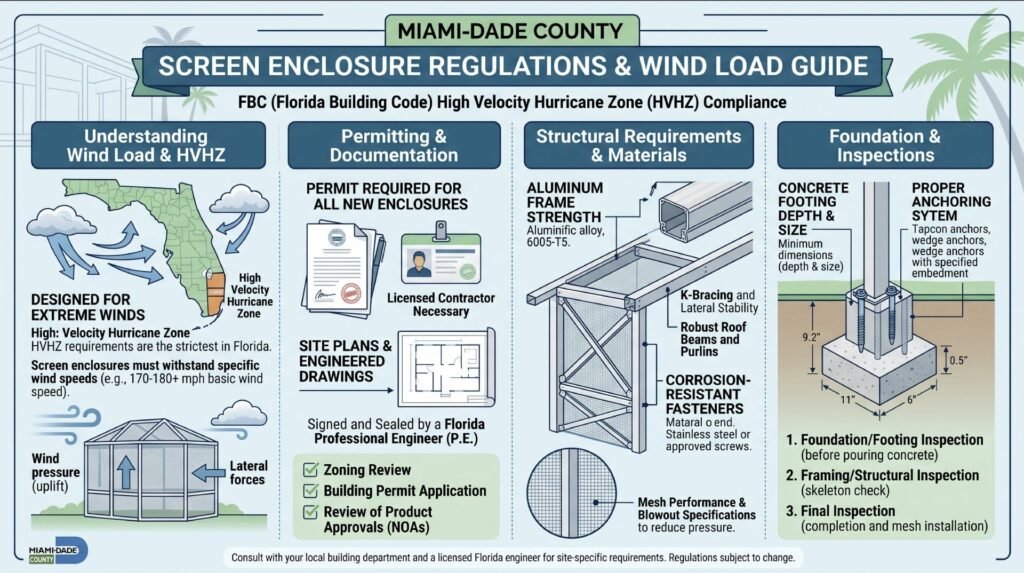
The Physics of Wind Load: How Miami-Dade Building Codes Shape Modern Screen Enclosures
When looking at a beautiful pool enclosure or a modern aluminum pergola in South Florida, it is easy to focus entirely on the aesthetics. You notice the seamless indoor-outdoor transition, the shade, and the relief from mosquitoes. However, in the High-Velocity Hurricane Zone (HVHZ) of Miami-Dade County, an outdoor enclosure is far more than a landscape feature. Legally and structurally, the county treats it as a permanent addition to your home.
Building an enclosure here requires a careful balance. You must merge architectural beauty with some of the most stringent engineering standards in the world.
1. The Physics of Wind Load: The “Sail Effect”
Many homeowners believe that hurricane winds pass right through screen mesh because it is full of tiny holes. Structural engineers know otherwise.
During a severe tropical storm or hurricane, torrential rain saturates the screen mesh. The water droplets fill the tiny voids in the weave. This process transforms a porous screen into a highly effective, solid sail. When wind gusts hit this saturated surface, they create immense aerodynamic pressure known as wind load.
[High Wind + Driving Rain] ---> [Saturated Screen Mesh] ---> [Solid Dynamic Barrier] ---> [Massive Lateral Pressure on Frame]
Current building regulations require structures in Miami-Dade to withstand ultimate design wind speeds ($V_{ult}$) between 170 mph and 180 mph. Your exact location and proximity to open terrain or the coast determine your specific zone (Exposure Categories C and D). If a contractor does not precisely calculate the structural aluminum geometry, bracing, and connections, the dynamic pressure can warp, buckle, or completely tear the enclosure from its concrete anchors.
2. Anatomy of a Hurricane-Ready Enclosure
Modern enclosures achieve wide, panoramic views without compromising safety. Instead of using bulky, sight-blocking posts, they rely on heavy-duty materials and clever structural physics.
Premium Materials That Make the Difference
-
Heavy-Gauge Structural Aluminum: Premium enclosures utilize high-tensile 6005-T5 alloy aluminum extrusions. This material offers an exceptional strength-to-weight ratio. It allows for thinner, sleeker profiles that still handle extreme lateral loads.
-
Picture Window Engineering: Traditional designs used frequent vertical posts every 3 to 4 feet to support the frame. Advanced engineering now allows for “Picture Window” designs. These massive spans of open view utilize reinforced header beams and specialized corner gussets to redirect wind stress down to the foundation.
-
K-Bracing and Structural Cables: The hidden geometry of an enclosure relies on K-bracing and high-strength stabilizing cables. These components act as tension and compression members. They prevent the rectangular frame from twisting when wind hits it diagonally.
The Fastener Factor: Standard zinc-plated steel screws are the Achilles’ heel of cheap enclosures. Exposed to Miami’s intense humidity, salt air, and pool chlorine, they rust out within a couple of seasons. This causes ugly orange bleeding and structural failure. High-authority builds rely exclusively on premium ceramic-coated fasteners or stainless steel screws capped with protective nylon heads (like Nylo-Tec) to eliminate galvanic corrosion.
3. Navigating the Permitting and Legal Process
A screen enclosure or a permanent aluminum pergola alters the structural profile of your property. Because of this, a licensed Florida structural engineer must sign and seal the engineering plans.
An unpermitted enclosure is a massive liability. Miami-Dade County Code Enforcement regularly issues severe fines and places liens on properties. They can even force homeowners to tear down non-compliant structures at their own expense. Furthermore, if an unpermitted structure damages your home during a hurricane, your property insurance provider will almost certainly deny the claim.
A professional, licensed contractor manages the entire workflow seamlessly:
-
Site Survey & Engineering: They draw up precise site plans factoring in setbacks and property lines.
-
HOA Approval Packages: They provide the exact structural blueprints required by strict homeowners’ associations in communities like Kendall, Doral, or Coral Gables.
-
Permit Acquisition: They submit signed and sealed drawings to the municipal building department and track the paperwork through approval.
-
Final Inspections: They ensure the structural anchors, ground faults, and setbacks pass the county inspector’s physical verification.
Investing in certified engineering isn’t just about code compliance. It protects your home’s equity, ensures family safety, and gives you absolute peace of mind when the next storm tracks toward the coast.
Frequently Asked Questions
Do I need a building permit to replace the screen panels on my patio in Miami-Dade?
If you are doing basic maintenance, such as replacing a few torn screen panels (re-screening), you do not need a full structural building permit. However, if you replace or alter any structural aluminum members, extend the frame, or install a brand-new enclosure, Miami-Dade County legally mandates a building permit.
What is the difference between standard screen mesh and heavy-duty options like TuffScreen?
Standard fiberglass screen mesh protects primarily against insects and lasts roughly 3 to 5 years under intense UV exposure. Manufacturers weave heavy-duty options, such as Phifer TuffScreen or PetScreen, from vinyl-coated polyester. They offer up to three times the strength of standard mesh, resist punctures from pets or flying storm debris, and resist UV degradation for over a decade.
Why do the screws on my screen enclosure look rusty, and is it dangerous?
The rust you see is galvanic corrosion. It happens when standard carbon steel fasteners interact with aluminum, water, and chlorine or salt air. It becomes highly dangerous over time. Rusted screws lose their shear strength, meaning the joints holding your heavy aluminum beams together can easily snap under a moderate wind storm. You should replace rusted fasteners with ceramic-coated or nylon-capped structural fasteners immediately.
Can a screen enclosure handle a Category 5 hurricane?
Engineers design enclosures to withstand the ultimate wind speeds associated with major hurricanes, provided they meet strict Miami-Dade High-Velocity Hurricane Zone standards. While severe storms may occasionally blow out individual screen panels, this actually acts as a pressure-relief valve for the frame. The structural aluminum skeleton itself will stand firm.
Build for Beauty. Engineer for Safety.
Don’t leave your outdoor living space to chance. At Palacios Screen & Enclosures, we combine over 19 years of South Florida craftsmanship with strict, code-compliant structural engineering. Whether you want to upgrade to a seamless Picture Window pool enclosure or install a modern aluminum pergola, our team handles the entire process—from signed-and-sealed engineering drawings to final county inspections.
Secure your property’s value and safety today. 📞 Call us at +1 (305) 979-6229 or Request a Free Estimate Online to schedule your professional structural consultation.